AI Agents and Automation: Transforming Intelligent Systems for Scalable Digital Excellence
Introduction to AI Agents and Intelligent Automation
In the rapidly evolving digital economy, AI agents and automation have emerged as foundational pillars for operational efficiency, innovation, and scalable growth. We are witnessing a paradigm shift where businesses no longer rely solely on traditional automation scripts but instead deploy intelligent, autonomous AI agents capable of learning, adapting, and executing complex workflows with minimal human intervention.
AI agents are not just tools; they are decision-making systems designed to perceive their environment, process contextual data, and act toward achieving predefined goals. When integrated with automation frameworks, they unlock unprecedented levels of productivity, accuracy, and strategic agility.
Understanding AI Agents: Architecture and Capabilities
What Are AI Agents?
AI agents are software entities powered by artificial intelligence that operate autonomously within digital environments. They utilize machine learning, natural language processing (NLP), and decision algorithms to perform tasks ranging from simple automation to advanced problem-solving.
Core Components of AI Agents
- Perception Layer: Gathers data from APIs, sensors, or user inputs
- Decision Engine: Uses algorithms and models to analyze and decide
- Action Module: Executes tasks based on decisions
- Learning System: Continuously improves through feedback and data
These components work cohesively to create systems that are context-aware, adaptive, and self-improving.
Automation Evolution: From Rule-Based to Intelligent Systems
Traditional Automation
Conventional automation relies on predefined rules and static workflows, limiting flexibility and scalability. While effective for repetitive tasks, it lacks adaptability.
Intelligent Automation
Modern automation integrates AI agents with robotic process automation (RPA), enabling:
- Dynamic decision-making
- Real-time data analysis
- Predictive execution
- Self-optimization
This shift allows organizations to move from task automation to process intelligence.
Key Benefits of AI Agents and Automation
1. Operational Efficiency at Scale
AI-driven automation eliminates manual bottlenecks, ensuring continuous, error-free execution of workflows across departments.
2. Cost Optimization
By reducing dependency on human intervention, organizations achieve significant cost savings while improving output quality.
3. Enhanced Decision-Making
AI agents analyze vast datasets in real time, enabling data-driven insights and faster strategic decisions.
4. 24/7 Availability
Unlike human resources, AI agents operate around the clock, ensuring uninterrupted service delivery.
5. Personalization and Customer Experience
AI systems enable hyper-personalized interactions, improving engagement and customer satisfaction.
Types of AI Agents in Automation Ecosystems
Reactive Agents
Operate based on immediate inputs without memory. Ideal for simple, real-time responses.
Model-Based Agents
Maintain internal representations of the environment, allowing more informed decision-making.
Goal-Oriented Agents
Act toward achieving specific objectives, optimizing actions to reach desired outcomes.
Learning Agents
Continuously improve through experience, making them highly adaptive and intelligent over time.
AI Agents in Business Automation: Real-World Applications
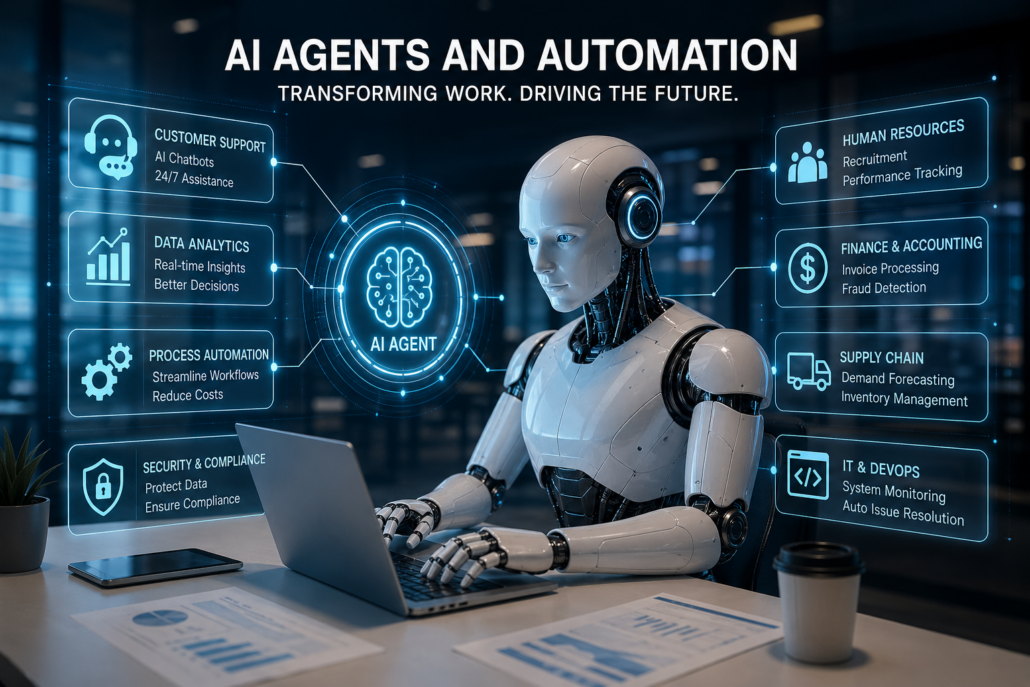
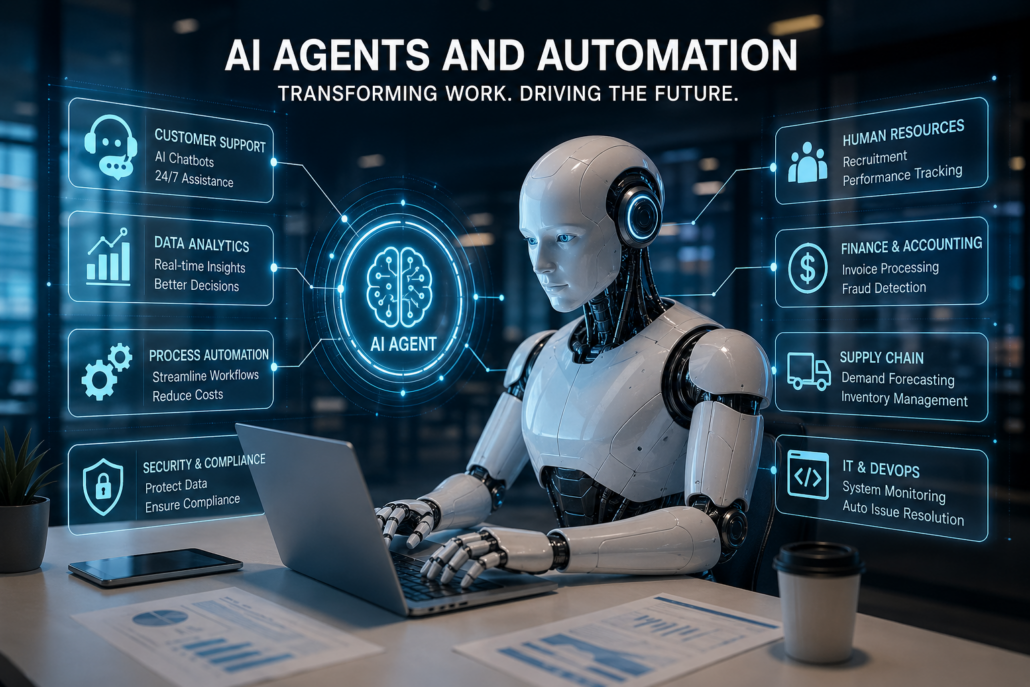
1. Customer Support Automation
AI-powered chatbots and virtual assistants handle:
- Customer queries
- Complaint resolution
- Order tracking
This results in faster response times and reduced operational costs.
2. Financial Process Automation
AI agents streamline:
- Invoice processing
- Fraud detection
- Risk assessment
Ensuring accuracy, compliance, and security.
3. Human Resource Management
Automation enhances:
- Recruitment screening
- Employee onboarding
- Performance tracking
Delivering efficient and data-driven HR operations.
4. Supply Chain Optimization
AI systems predict demand, manage inventory, and optimize logistics, leading to reduced waste and improved delivery efficiency.
5. IT and DevOps Automation
AI agents monitor systems, detect anomalies, and execute corrective actions, ensuring system reliability and uptime.
Technologies Powering AI Agents and Automation
Machine Learning (ML)
Enables systems to learn patterns and improve performance over time.
Natural Language Processing (NLP)
Allows AI agents to understand and respond to human language effectively.
Computer Vision
Empowers systems to interpret visual data for applications such as surveillance and quality control.
Robotic Process Automation (RPA)
Automates repetitive digital tasks, enhanced by AI for intelligent execution.
Cloud Computing
Provides scalable infrastructure for deploying and managing AI systems globally.
Designing Effective AI Automation Systems
Define Clear Objectives
Identify processes that benefit most from automation, focusing on high-impact, repetitive tasks.
Data Strategy
Ensure access to clean, structured, and relevant data for optimal AI performance.
Integration Framework
Seamlessly integrate AI agents with existing systems such as CRM, ERP, and APIs.
Continuous Monitoring and Optimization
Implement feedback loops to refine and enhance system performance.
Challenges and Considerations
Data Privacy and Security
AI systems must comply with data protection regulations and ensure secure handling of sensitive information.
Implementation Complexity
Deploying AI agents requires technical expertise and strategic planning.
Change Management
Organizations must adapt workflows and train teams to collaborate with AI systems effectively.
Ethical AI Usage
Ensuring transparency, fairness, and accountability in AI decision-making is critical.
Future of AI Agents and Automation
The trajectory of AI agents points toward fully autonomous enterprise ecosystems where intelligent systems manage end-to-end operations with minimal human intervention.
Key trends include:
- Multi-agent collaboration systems
- Self-healing IT infrastructures
- Autonomous business processes
- AI-driven innovation platforms
As these technologies mature, organizations that adopt early will gain significant competitive advantages.
Conclusion: Strategic Adoption for Competitive Advantage
AI agents and automation are no longer optional—they are strategic imperatives for organizations aiming to thrive in a digital-first world. By leveraging intelligent systems, we unlock efficiency, scalability, and innovation at unprecedented levels.
The integration of AI agents into automation frameworks enables businesses to transform operations, enhance customer experiences, and drive sustainable growth. The future belongs to those who embrace intelligent automation as a core component of their digital strategy. Contact Musato Technologies to learn more about our AI powered solutions and services.