
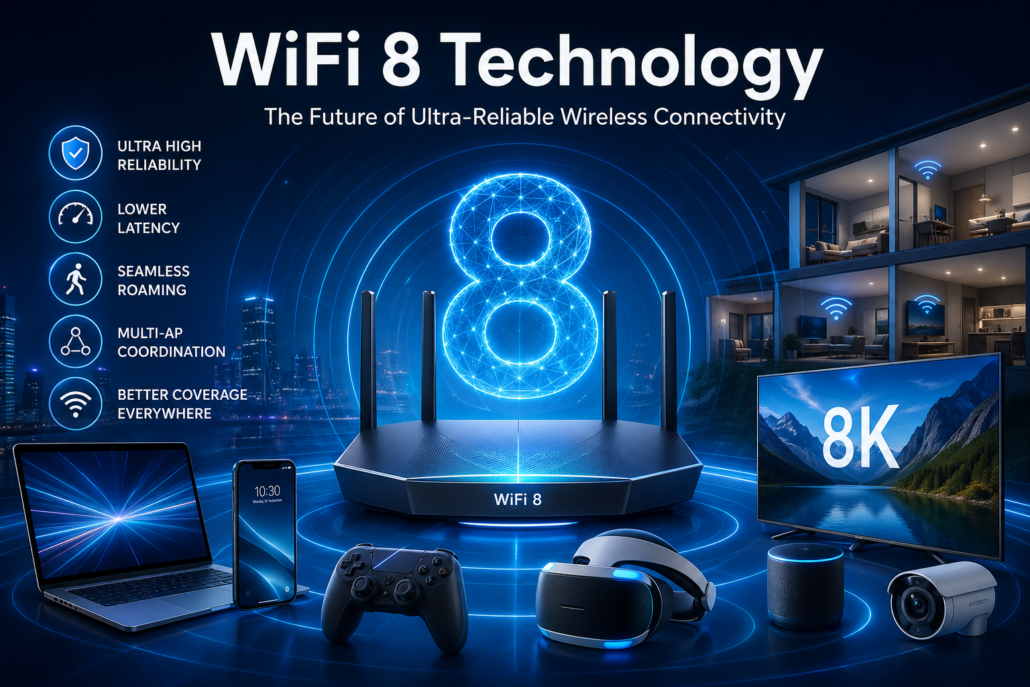
WiFi 8 Technology: The Future of Ultra-Reliable Wireless Connectivity
Wireless networking continues to evolve rapidly, and WiFi 8 Technology is set to become the next major milestone in digital connectivity. While previous generations focused heavily on raw speed, WiFi 8 is being designed to prioritize stability, lower latency, seamless roaming, stronger coverage, and dependable real-world performance. This shift is significant because modern homes, offices, factories, and smart cities require more than fast downloads—they need uninterrupted, intelligent, and responsive wireless communication.
Known technically as IEEE 802.11bn, WiFi 8 represents a major leap toward Ultra High Reliability (UHR) networking. It is expected to power the next generation of connected devices, enterprise systems, automation platforms, gaming environments, cloud applications, and immersive technologies. IEEE Wi-Fi Alliance
What Is WiFi 8 Technology?
WiFi 8 is the upcoming wireless standard that succeeds WiFi 7. Unlike earlier upgrades that mainly advertised faster theoretical speeds, WiFi 8 is engineered to improve the quality of wireless experiences in crowded, high-demand, and interference-heavy environments.
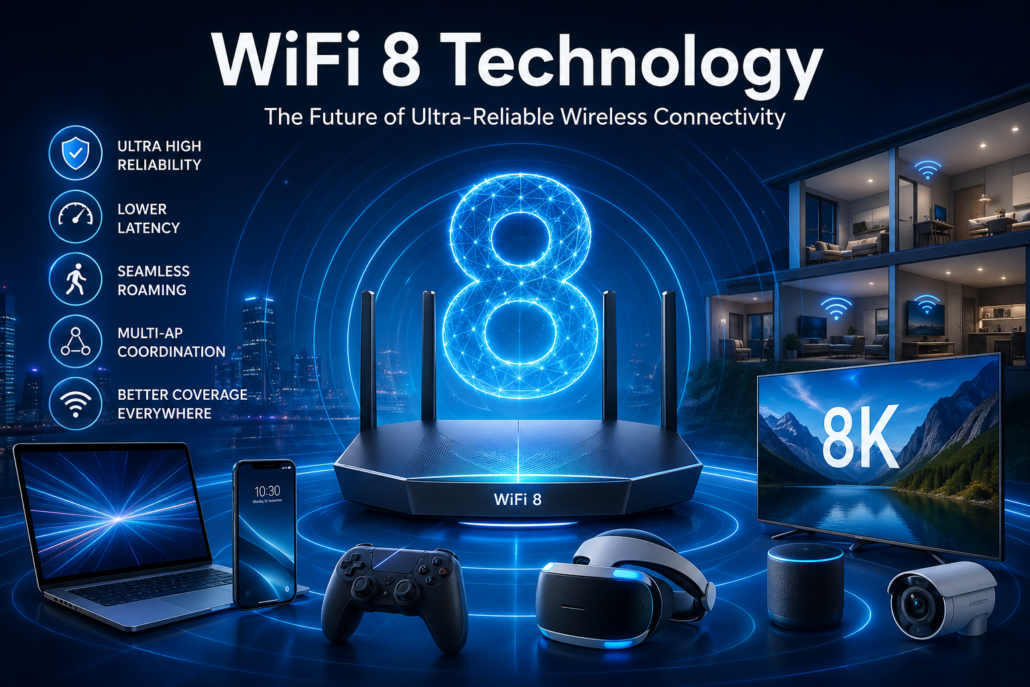
This means users can expect:
- More stable video calls
- Smoother online gaming
- Faster handoff between access points
- Better performance in apartment buildings
- Reliable smart home automation
- Lower lag for cloud computing
- Improved enterprise productivity
Instead of only asking “How fast is the network?”, WiFi 8 asks, “How consistently can the network perform?”
Why WiFi 8 Matters More Than Ever
Today’s connected world is very different from the past. One household may have:
- Smartphones
- Laptops
- Tablets
- Smart TVs
- Security cameras
- Gaming consoles
- Voice assistants
- Smart appliances
- Wearables
Businesses often operate hundreds or thousands of connected endpoints. Traditional wireless systems can struggle when too many devices compete for bandwidth. WiFi 8 addresses this challenge by improving coordination, reliability, and spectrum efficiency.
That makes it especially valuable for:
- Dense urban housing
- Offices and campuses
- Airports and stadiums
- Warehouses
- Hospitals
- Smart factories
- Remote work environments
Key Features of WiFi 8 Technology
1. Ultra High Reliability
WiFi 8 aims to deliver highly dependable connections with fewer interruptions, reduced packet loss, and better signal consistency. This is crucial for video conferencing, remote operations, and business-critical workflows.
2. Lower Latency Performance
Latency is the delay between sending and receiving data. WiFi 8 is expected to reduce latency significantly, improving:
- Online gaming
- Video meetings
- AR and VR experiences
- Remote control systems
- Industrial automation
3. Multi-Access Point Coordination
One of the biggest innovations in WiFi 8 is enhanced communication between multiple access points. Instead of routers competing with one another, they can coordinate transmissions intelligently.
Benefits include:
- Better coverage
- Fewer dead zones
- Improved roaming
- Less interference
- Stronger building-wide performance
4. Improved Roaming
Moving from room to room or floor to floor often causes signal drops. WiFi 8 is being optimized for smoother transitions between network nodes, ideal for mesh systems and enterprise campuses.
5. Better Edge Performance
Devices far from the router usually experience poor speeds. WiFi 8 is designed to maintain stronger performance even at the network edge, where weaker signals typically cause frustration.
WiFi 8 vs WiFi 7
| Feature | WiFi 7 | WiFi 8 |
|---|---|---|
| Focus | Maximum Speed | Reliability + Stability |
| Latency | Very Low | Even Lower |
| Multi-AP Coordination | Limited | Advanced |
| Dense Environment Performance | Strong | Excellent |
| Roaming | Good | Seamless |
| Real-World Consistency | High | Superior |
While WiFi 7 remains powerful, WiFi 8 is expected to feel better in everyday use because consistency often matters more than peak numbers.
How Fast Will WiFi 8 Be?
WiFi 8 may not dramatically raise headline speed limits beyond WiFi 7. Instead, the goal is to make existing speeds more usable and stable.
That means:
- Faster real downloads
- Better sustained streaming
- More responsive cloud apps
- Consistent gaming sessions
- Reliable large file transfers
This practical approach benefits users more than marketing-driven peak speed figures.
Best Use Cases for WiFi 8 Technology
Smart Homes
WiFi 8 will improve performance for homes running many connected devices simultaneously.
Remote Work
Stable calls, secure collaboration, and uninterrupted cloud access become easier.
Gaming
Gamers benefit from lower ping, reduced jitter, and fewer disconnects.
Healthcare
Hospitals need dependable wireless systems for connected devices and patient monitoring.
Industrial Automation
Factories using robotics, sensors, and machine control require ultra-reliable low-latency networks.
Education Campuses
Schools and universities can support thousands of simultaneous users more efficiently.
Will You Need New Hardware for WiFi 8?
Yes. To use WiFi 8 features fully, users will need:
- WiFi 8 compatible routers
- WiFi 8 supported phones/laptops
- Updated mesh systems
- Compatible network adapters
Older devices will still connect, but advanced capabilities may require newer hardware.
When Will WiFi 8 Be Available?
Industry development is underway, with standardization progressing now. Wider commercial adoption is expected to expand closer to the final certification cycle over the coming years. Early chipsets, prototype devices, and enterprise testing are already appearing in the market.
Should You Wait for WiFi 8?
If you urgently need a router today, modern WiFi 6E or WiFi 7 solutions remain excellent. However, if long-term infrastructure planning matters, WiFi 8 is worth monitoring closely because it emphasizes what users truly need:
- Dependability
- Coverage
- Low latency
- Seamless mobility
- Multi-device efficiency
The Future of Wireless Networking
WiFi 8 Technology signals a new era where wireless systems behave more like wired networks—stable, predictable, and always responsive. That shift will reshape how homes, businesses, public venues, and industries connect.
As digital transformation accelerates, the next generation of wireless success will not be measured only in gigabits per second. It will be measured in trust, uptime, responsiveness, and reliability.
WiFi 8 is built for exactly that future. Contact Musato Technologies today to learn more about our networking services and solutions.

Author: Alden S. Marwick
Alden S. Marwick is the driving force behind seamless digital ecosystems at Musato Technologies. With a strong background in systems engineering, API architecture, cloud technologies, and enterprise software alignment, Alden ensures that all digital platforms work together efficiently, securely, and intelligently. He specializes in building scalable integration frameworks that support business growth, operational efficiency, and long-term digital transformation. Whether optimizing ERP and CRM communication, automating workflows, or simplifying cross-platform data exchange, Alden brings structure, precision, and innovation to every solution. His work focuses on reducing technical complexity and enabling businesses to operate with clarity and confidence. With a leadership style rooted in methodical analysis and modern technology strategy,