Cyber Security Solutions for Businesses
Cyber threats have become a fundamental business risk. Organizations of every size now depend on cloud platforms, connected devices, business applications, remote access, digital payments, and large volumes of sensitive data. As technology becomes more deeply integrated into everyday operations, the potential impact of a cyberattack increases. Effective cyber security solutions for businesses therefore need to protect not only computers and networks, but the entire digital environment in which an organization operates.
We provide comprehensive cybersecurity strategies designed to identify vulnerabilities, prevent attacks, detect suspicious activity, respond quickly to incidents, and strengthen an organization’s long-term security posture. Our approach combines technology, security expertise, continuous monitoring, employee awareness, risk management, and clearly defined response procedures.
What Are Cyber Security Solutions for Businesses?
Business cybersecurity encompasses the policies, technologies, processes, and professional services used to protect an organization’s digital assets from unauthorized access, disruption, theft, manipulation, and destruction.
A modern cybersecurity strategy typically protects business networks, endpoints, cloud environments, applications, identities, email systems, databases, websites, and confidential information. It also addresses the people and processes that interact with these systems.
We approach cybersecurity as a complete business function rather than a collection of isolated security products. Firewalls and antivirus software remain useful, but they are only individual components of a broader security architecture. Effective protection requires multiple layers that work together.
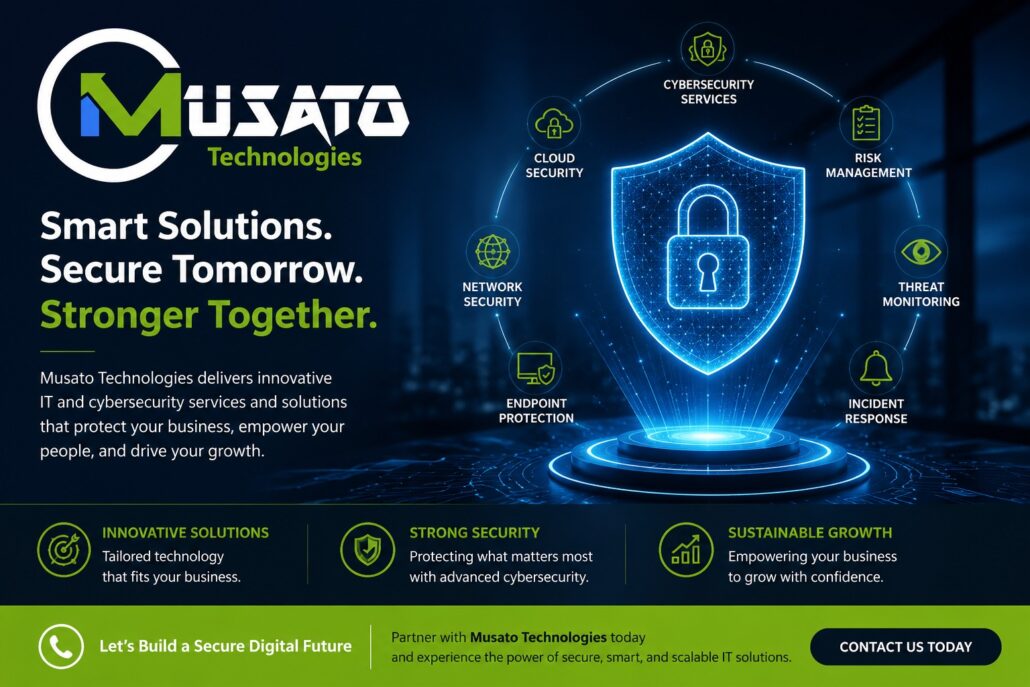
Our cybersecurity solutions can include:
- Network security
- Endpoint protection
- Cloud security
- Email security
- Identity and access management
- Multi-factor authentication
- Vulnerability assessments
- Penetration testing
- Security monitoring
- Threat detection and response
- Data protection and encryption
- Backup and disaster recovery
- Security awareness training
- Incident response planning
- Compliance and risk management
Why Businesses Need Professional Cybersecurity
Cyberattacks are not limited to large enterprises. Small and medium-sized businesses can also be attractive targets because they frequently hold valuable customer information, financial records, intellectual property, credentials, and commercially sensitive data.
A successful attack can result in financial losses, operational downtime, reputational damage, regulatory consequences, legal expenses, and the loss of customer confidence.
We help businesses move from a reactive security model to a proactive cybersecurity strategy. Instead of waiting until an incident occurs, we identify weaknesses in advance and implement controls designed to reduce the likelihood and potential impact of an attack.
The objective is not simply to install security software. It is to create a resilient environment in which threats can be identified and contained before they become major business disruptions.
Managed Cyber Security Services
Businesses often lack the internal resources required to monitor their environments continuously. Cyber threats do not operate according to normal office hours, which makes ongoing security monitoring particularly important.
Managed cybersecurity services provide organizations with access to security expertise and technologies without requiring them to build a large internal security operation.
We can support organizations through continuous security monitoring, threat detection, vulnerability management, endpoint protection, security alerts, incident investigation, and reporting.
A managed security approach can be particularly valuable for organizations that have limited internal IT security resources or need additional expertise to complement an existing IT department.
Network Security Solutions
Business networks connect employees, servers, applications, cloud services, offices, suppliers, and customers. Protecting this infrastructure is therefore a critical part of an effective cybersecurity program.
Our network security approach can include firewalls, secure remote access, network segmentation, intrusion detection, intrusion prevention, secure wireless configuration, traffic monitoring, and access controls.
Network segmentation is especially important because it can limit the ability of an attacker to move through an environment after gaining unauthorized access. By separating critical systems and restricting unnecessary communication between network segments, businesses can reduce the potential scope of an incident.
We also review network configurations regularly to identify unnecessary services, excessive permissions, outdated technologies, and other weaknesses that could increase exposure.
Endpoint Security for Business Devices
Laptops, desktops, mobile devices, servers, and other endpoints represent important entry points into business environments.
Endpoint security combines technologies and processes designed to protect these devices from malware, ransomware, unauthorized applications, credential theft, and other threats.
We can implement endpoint protection with centralized monitoring and management, helping businesses maintain visibility across their device fleet. Security controls can include malware protection, behavioral detection, device control, application management, patching, and endpoint detection and response capabilities.
Keeping operating systems and applications properly updated is another essential component. Vulnerabilities in outdated software can provide attackers with opportunities to compromise otherwise well-protected systems.
Cloud Security Solutions
Cloud computing has transformed the way businesses store information and deliver applications. However, moving infrastructure to the cloud does not eliminate cybersecurity responsibilities.
Cloud security requires appropriate configuration of identities, permissions, storage, applications, networks, logging, authentication, and data.
We help organizations assess cloud environments and establish appropriate security controls. This includes reviewing user privileges, enforcing strong authentication, protecting sensitive information, monitoring activity, and reducing unnecessary exposure.
A least-privilege approach ensures that users and applications receive only the access they genuinely require. Restricting excessive permissions can significantly reduce the potential consequences of compromised accounts.
Email Security and Phishing Protection
Email remains one of the most commonly exploited channels for cybercrime. Attackers can use convincing messages to persuade employees to reveal credentials, open malicious attachments, transfer funds, or visit fraudulent websites.
Our email security strategies combine technical controls with employee awareness. Email filtering, malicious-link detection, attachment analysis, authentication controls, impersonation protection, and security awareness training can work together to reduce phishing risk.
Technology alone is not sufficient. Employees are an important component of an organization’s security architecture, which makes cybersecurity awareness training an essential investment.
Vulnerability Assessment and Penetration Testing
Businesses cannot effectively protect weaknesses they have not identified.
Vulnerability assessments help organizations discover known security weaknesses across systems, applications, devices, and infrastructure. We prioritize identified vulnerabilities according to their potential business impact so that security teams can focus resources where they are most needed.
Penetration testing goes further by using controlled security testing to determine whether vulnerabilities can realistically be exploited. Testing can help organizations understand how attackers might enter systems, escalate privileges, access sensitive information, or move between systems.
Regular security assessments provide an opportunity to identify weaknesses before malicious actors discover them.
Ransomware Protection and Recovery – Cyber Security Solutions for Businesses
Ransomware can prevent organizations from accessing critical files and systems while attackers demand payment for restoration. Prevention is therefore important, but businesses must also prepare for the possibility that defensive controls could be bypassed.
We recommend a layered ransomware strategy incorporating endpoint protection, access controls, patch management, network segmentation, email security, employee training, monitoring, and reliable backups.
Backups should be appropriately protected from unauthorized modification or deletion and tested regularly. A backup that cannot be successfully restored when required does not provide dependable business continuity.
Identity and Access Management
Compromised credentials can provide attackers with legitimate-looking access to business systems.
Identity security focuses on ensuring that the right people have the right access to the right resources at the right time.
We implement controls such as multi-factor authentication, role-based access, privileged account management, strong password policies, access reviews, and automated account lifecycle management.
Access should also be removed or adjusted promptly when employees change roles or leave an organization. Regular reviews help identify accounts and permissions that are no longer necessary.
Incident Response and Cybersecurity Resilience
Even organizations with strong security controls need an incident response plan. The speed and effectiveness of the response can significantly influence the ultimate impact of a security incident.
We help businesses establish procedures for identifying, containing, investigating, remediating, and recovering from cybersecurity incidents.
An effective incident response plan should define responsibilities, escalation procedures, communication channels, evidence-handling processes, recovery priorities, and decision-making authority.
Regular exercises can help organizations identify weaknesses in their response plans before a real incident occurs.
Cybersecurity Compliance and Risk Management
Cybersecurity is closely connected to regulatory requirements, contractual obligations, privacy responsibilities, and industry standards.
We help organizations understand their security risks and implement appropriate controls based on their operational requirements and regulatory environment.
A structured cybersecurity risk assessment considers valuable assets, potential threats, existing controls, vulnerabilities, business consequences, and risk tolerance. This allows cybersecurity investments to be prioritized according to actual business needs rather than simply purchasing the latest security technologies.
Security Awareness Training for Employees
Employees can either strengthen or weaken an organization’s cybersecurity posture. Regular training helps employees recognize suspicious emails, social engineering attempts, unsafe websites, fraudulent requests, and other common attack techniques.
We encourage organizations to make security awareness an ongoing process rather than a once-a-year exercise.
Training can cover phishing, password security, authentication, safe browsing, mobile security, data handling, social engineering, physical security, and procedures for reporting suspicious activity.
Creating a culture in which employees feel comfortable reporting potential incidents can help organizations respond earlier.
Choosing the Right Cyber Security Solutions for Your Business
There is no single cybersecurity solution that is appropriate for every organization. The right strategy depends on factors such as business size, industry, technology infrastructure, regulatory requirements, remote-working arrangements, cloud adoption, data sensitivity, and risk profile.
We begin with an assessment of the existing environment and identify the most significant security gaps. From there, we develop a prioritized roadmap covering immediate vulnerabilities, strategic improvements, monitoring requirements, employee awareness, and incident preparedness.
The goal is to create practical, scalable, and measurable cybersecurity protection that supports business operations rather than unnecessarily complicating them.
Build a Stronger Cybersecurity Strategy
Cybersecurity should be treated as an ongoing business priority. Threats evolve, technologies change, employees join and leave organizations, applications are updated, and new vulnerabilities are discovered continuously.
We provide businesses with a layered approach to cybersecurity that combines prevention, detection, response, recovery, and continuous improvement.
By strengthening networks, endpoints, identities, applications, cloud environments, employees, and operational processes, organizations can reduce their exposure to cyber threats while building greater confidence in their digital infrastructure.
A strong cybersecurity strategy does more than protect technology. It protects business continuity, sensitive information, customer trust, operational resilience, and the long-term reputation of the organization.
Partner with Musato Technologies and take a proactive approach to cybersecurity.
Contact Musato Technologies today for a cybersecurity assessment and discover where your business may be vulnerable. In addition, you will learn more about our Cyber Security Solutions for Businesses.