
Close
We enable business and digital transformation decisions through the delivery of cutting-edge ICT solutions and products...
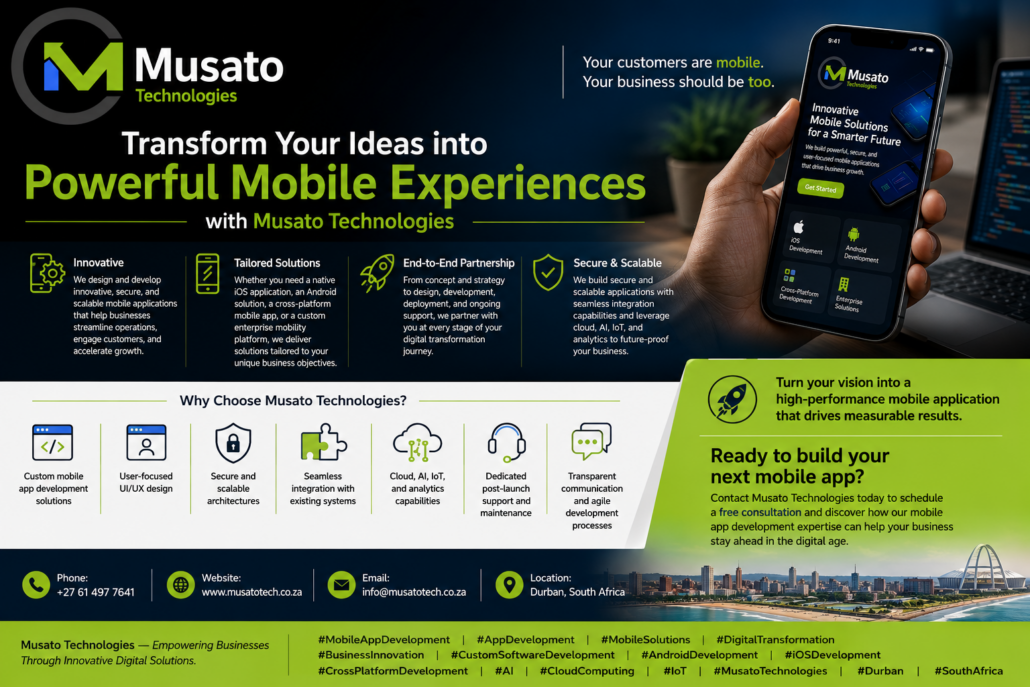
In today’s digital economy, mobile applications have become essential business assets that drive customer engagement, improve operational efficiency, and unlock new revenue opportunities. Organizations across industries are leveraging innovative mobile technologies to create seamless digital experiences that meet evolving customer expectations. Musato Technologies offers innovative and smart mobile app development solutions to businesses or organizations of any size.
Whether serving consumers, empowering employees, or streamlining internal workflows, modern mobile app development solutions provide businesses with the tools needed to remain competitive in an increasingly mobile-first marketplace.
The widespread adoption of smartphones and tablets has fundamentally transformed how people interact with businesses. Customers expect instant access to products, services, and information through intuitive and responsive mobile applications.
Effective mobile app development solutions enable organizations to:
Businesses that invest in robust mobile solutions position themselves to adapt quickly to changing market demands while creating meaningful digital experiences for their audiences.
Mobile app development encompasses the design, creation, deployment, and maintenance of software applications specifically built for mobile devices. Successful solutions integrate user-centric design, advanced technologies, secure architectures, and scalable infrastructure.
Modern mobile applications typically include:
A strategic approach to mobile development ensures that applications deliver exceptional performance while supporting future growth.
Native applications are developed specifically for a single operating system using platform-specific programming languages and tools.
For iOS applications, developers typically use:
For Android applications, developers commonly use:
Native development offers several advantages:
Native applications are ideal for businesses requiring high-performance solutions, complex functionality, or extensive hardware integration.
Cross-platform frameworks allow developers to build applications that run across multiple operating systems using a single codebase.
Popular frameworks include:
Key benefits include:
Cross-platform development is particularly beneficial for startups and organizations seeking cost-effective mobile solutions.
Progressive Web Applications combine the accessibility of websites with the functionality of native applications.
Key features include:
PWAs offer an efficient solution for businesses looking to reach users without requiring app store downloads.
User experience directly influences application adoption and retention. Mobile apps must deliver:
A user-centered design approach minimizes friction and encourages long-term engagement.
Mobile applications handle sensitive user information, making security a critical priority.
Essential security measures include:
Organizations must implement security protocols that comply with relevant regulatory standards and industry best practices.
Cloud technologies enable mobile applications to deliver scalable, flexible, and cost-efficient services.
Benefits of cloud integration include:
Cloud-based architectures support business continuity and facilitate rapid growth.
Data-driven decision-making requires comprehensive analytics capabilities.
Effective mobile applications track:
Continuous monitoring enables organizations to optimize functionality and improve user experiences.
AI-powered mobile applications deliver personalized experiences through:
Machine learning algorithms continuously improve application performance based on user interactions.
IoT-enabled mobile applications connect users with smart devices and systems.
Common use cases include:
IoT integration creates connected ecosystems that enhance efficiency and convenience.
AR and VR technologies are reshaping mobile experiences across industries.
Applications include:
Immersive technologies improve engagement and create memorable user interactions.
Blockchain enhances transparency and security within mobile applications.
Benefits include:
Industries such as finance, healthcare, and supply chain management increasingly rely on blockchain-powered mobile solutions.
A structured development process ensures successful project delivery.
This phase involves:
Clear objectives establish the foundation for successful development.
Design teams create:
Well-designed interfaces improve usability and user satisfaction.
Developers build core functionalities while integrating required technologies and APIs.
Key activities include:
Agile methodologies enable iterative development and continuous improvement.
Comprehensive testing ensures application reliability.
Testing activities include:
Rigorous quality assurance minimizes defects and enhances user experiences.
Deployment involves:
Successful launches require careful planning and ongoing support.
Mobile applications require regular updates to maintain performance and relevance.
Ongoing activities include:
Continuous improvement drives long-term success.
Selecting an experienced development partner significantly impacts project outcomes.
Consider the following factors:
A reliable partner aligns technology strategies with business objectives while delivering scalable and future-ready solutions.
Organizations that implement strategic mobile initiatives gain measurable advantages, including:
Mobile applications are no longer optional tools—they are essential platforms for delivering value, building relationships, and driving digital transformation.
The future of mobile app development will be shaped by:
Businesses that embrace these innovations will be better positioned to meet changing user expectations and capitalize on emerging opportunities.
Modern mobile app development solutions empower organizations to create engaging, secure, and scalable digital experiences that deliver measurable business outcomes. By combining strategic planning, user-centric design, advanced technologies, and continuous optimization, businesses can build applications that strengthen customer relationships and accelerate growth.
Investing in the right mobile app development strategy ensures long-term competitiveness in an increasingly connected world. Organizations that prioritize innovation, security, and user experience will continue to lead in the evolving digital landscape. Contact Musato Technologies to learn more about our mobile application development solutions.

Dr. Liana Mokoena is an accomplished Lead Software Engineer and Solutions Architect specializing in custom software development, mobile applications, and scalable system architecture. She excels at translating business requirements into powerful digital solutions and leads development teams with precision and innovation. Liana is a forward-thinking engineer with deep experience in designing and leading the development of enterprise-level systems. Her expertise ensures that every solution delivered is scalable, secure, and aligned with business goals. She is passionate about building technology that transforms industries.
Leave a Reply
You must be logged in to post a comment.