Adopt AI, Digital Tools, and Cybersecurity to Help You Grow and Remain Competitive
In today’s rapidly evolving digital economy, businesses that embrace Artificial Intelligence (AI), digital transformation, and cybersecurity are positioning themselves to outperform competitors, improve operational efficiency, and deliver exceptional customer experiences. Organizations that continue relying on outdated systems and manual processes risk falling behind in an increasingly technology-driven marketplace.
As businesses, we must recognize that digital innovation is no longer optional—it is essential for sustainable growth, profitability, and resilience. By strategically adopting AI-powered solutions, modern digital tools, and enterprise-grade cybersecurity practices, we can transform operations, increase productivity, reduce costs, and unlock new opportunities for innovation.
Why Digital Transformation Is Critical for Business Success
Digital transformation is the integration of modern technologies into every aspect of business operations. It changes how we serve customers, manage employees, analyze information, and compete in our industries.
A successful digital transformation enables us to:
- Increase operational efficiency
- Reduce repetitive manual work
- Improve customer satisfaction
- Strengthen decision-making
- Accelerate innovation
- Expand into new markets
- Increase profitability
- Respond quickly to changing market conditions
Organizations that successfully digitize their operations become more agile, scalable, and resilient against economic uncertainty.
Artificial Intelligence: The Future of Business Innovation
Artificial Intelligence has become one of the most transformative technologies available today. AI is helping organizations automate complex tasks, improve customer interactions, and generate valuable business insights from massive amounts of data.
How AI Benefits Modern Businesses
1. Intelligent Automation
AI eliminates repetitive administrative tasks by automating:
- Data entry
- Invoice processing
- Customer onboarding
- Appointment scheduling
- Document management
- HR processes
- Inventory updates
This allows employees to focus on strategic work that creates greater business value.
2. Enhanced Customer Service
AI-powered chatbots and virtual assistants provide:
- 24/7 customer support
- Instant responses
- Personalized recommendations
- Faster issue resolution
- Improved customer satisfaction
Businesses can serve more customers without significantly increasing operational costs.
3. Smarter Business Decisions
AI analyzes large datasets within seconds and identifies patterns that humans might overlook.
Business leaders gain insights into:
- Sales performance
- Customer behavior
- Financial forecasting
- Market trends
- Operational bottlenecks
- Risk management
Data-driven decisions reduce uncertainty and improve long-term planning.
4. Predictive Analytics
Predictive AI enables businesses to anticipate future outcomes by analyzing historical data.
Applications include:
- Sales forecasting
- Demand prediction
- Equipment maintenance
- Fraud detection
- Customer retention
- Marketing optimization
Predictive intelligence gives organizations a competitive advantage by allowing proactive decision-making.
5. Personalized Customer Experiences
Modern consumers expect personalized interactions.
AI enables businesses to provide:
- Customized product recommendations
- Personalized email marketing
- Targeted advertising
- Individual pricing strategies
- Tailored customer journeys
Higher personalization leads to increased customer loyalty and higher conversion rates.
Essential Digital Tools Every Business Should Adopt
Digital tools improve collaboration, communication, productivity, and operational efficiency across every department.
Cloud Computing
Cloud solutions provide:
- Secure remote access
- Automatic backups
- Business continuity
- Lower infrastructure costs
- Scalability
- Improved collaboration
Employees can securely access business systems from anywhere.
Customer Relationship Management (CRM)
CRM platforms help organizations:
- Manage customer interactions
- Track sales pipelines
- Improve customer retention
- Automate follow-ups
- Generate reports
- Increase sales productivity
A centralized customer database creates better customer experiences.
Enterprise Resource Planning (ERP)
ERP systems integrate multiple business functions including:
- Finance
- Procurement
- Inventory
- Human Resources
- Manufacturing
- Logistics
- Project Management
ERP software provides complete visibility across business operations.
Business Intelligence Dashboards
Real-time dashboards allow decision-makers to monitor:
- Revenue
- Expenses
- Customer growth
- Marketing performance
- Employee productivity
- Operational KPIs
Accurate data supports faster and more informed decisions.
Digital Collaboration Platforms
Remote and hybrid work require reliable collaboration tools.
Digital collaboration platforms improve:
- Communication
- File sharing
- Video conferencing
- Team productivity
- Project coordination
- Workflow management
Efficient collaboration accelerates project delivery and innovation.
Workflow Automation Software
Workflow automation eliminates unnecessary manual processes by automatically routing tasks between departments.
Benefits include:
- Faster approvals
- Reduced errors
- Increased productivity
- Better compliance
- Lower operating costs
Automation enables organizations to scale without proportionally increasing staffing costs.
Cybersecurity: Protecting Business Growth
As businesses become increasingly digital, cyber threats continue to grow in sophistication.
Cybersecurity is no longer an IT issue—it is a business priority.
Every organization handles valuable information including:
- Customer records
- Financial data
- Employee information
- Intellectual property
- Business strategies
Protecting these assets is essential for maintaining trust and ensuring business continuity.
Common Cybersecurity Threats Facing Businesses
Organizations today face numerous cyber risks, including:
- Ransomware attacks
- Phishing emails
- Business Email Compromise (BEC)
- Data breaches
- Malware infections
- Identity theft
- Credential theft
- Insider threats
- Cloud security vulnerabilities
- Social engineering attacks
Without proper protection, a single cyber incident can result in significant financial losses and reputational damage.
Best Cybersecurity Practices for Modern Organizations
Implement Multi-Factor Authentication (MFA)
Passwords alone are no longer sufficient.
Multi-Factor Authentication adds an additional security layer, significantly reducing unauthorized access.
Regular Security Updates
Software vendors continuously release security patches.
Keeping systems updated protects businesses from known vulnerabilities and cyber exploits.
Employee Cybersecurity Awareness Training
Human error remains one of the leading causes of cyber incidents.
Employees should receive regular training on:
- Phishing detection
- Password security
- Safe internet practices
- Data protection
- Social engineering awareness
- Secure remote working
An informed workforce is one of the strongest cybersecurity defenses.
Data Encryption
Sensitive information should always be encrypted:
- At rest
- In transit
- During backups
Encryption protects data even if systems are compromised.
Regular Data Backups
Businesses should maintain automated backups stored securely both onsite and offsite.
Reliable backups allow rapid recovery after ransomware attacks or system failures.
Network Security Monitoring
Continuous monitoring identifies suspicious activities before they become serious security incidents.
Modern monitoring solutions detect:
- Unauthorized access
- Malware activity
- Network anomalies
- Insider threats
- Data exfiltration
Early detection minimizes damage.
The Role of AI in Cybersecurity
Artificial Intelligence is revolutionizing cybersecurity by enabling real-time threat detection and automated incident response.
AI-powered cybersecurity solutions can:
- Detect unusual behavior
- Analyze millions of security events
- Identify zero-day attacks
- Block malicious traffic
- Prevent fraud
- Automate threat response
- Reduce response times
AI significantly enhances traditional cybersecurity capabilities.
Building a Competitive Advantage Through Technology
Organizations that combine AI, digital tools, and cybersecurity gain measurable competitive advantages.
These include:
- Faster innovation
- Improved customer experiences
- Reduced operating costs
- Increased productivity
- Better employee collaboration
- Greater operational resilience
- Stronger regulatory compliance
- Enhanced business intelligence
- Scalable growth
- Improved profitability
Technology enables businesses to adapt faster than competitors and respond effectively to changing customer expectations.
Developing a Future-Ready Digital Strategy
Successful organizations adopt technology strategically rather than reactively.
A comprehensive digital strategy should include:
- Business process assessment
- Digital transformation roadmap
- AI implementation plan
- Cloud migration strategy
- Cybersecurity framework
- Data governance policies
- Employee digital skills development
- Technology investment planning
- Continuous innovation initiatives
- Performance measurement
A structured approach ensures long-term success while maximizing return on technology investments.
Preparing Employees for Digital Success
Technology alone does not guarantee success.
Employees must be empowered through:
- Digital literacy training
- AI awareness programs
- Cybersecurity education
- Change management initiatives
- Leadership development
- Continuous professional learning
Organizations that invest in people alongside technology achieve stronger transformation outcomes.
Why Small and Medium Businesses Should Adopt AI Now
Artificial Intelligence is no longer reserved for large enterprises.
Affordable cloud-based AI solutions enable small and medium businesses to:
- Automate customer service
- Improve marketing campaigns
- Optimize inventory
- Generate business insights
- Increase sales
- Reduce operational costs
- Improve forecasting
- Enhance customer engagement
SMEs adopting AI today position themselves for sustained growth in increasingly competitive markets.
Digital Innovation Drives Long-Term Growth
Innovation is essential for maintaining relevance in today’s economy.
Organizations embracing digital innovation benefit from:
- Continuous process improvement
- Increased agility
- Better customer relationships
- Improved financial performance
- Stronger market positioning
- Sustainable competitive advantage
Digital innovation creates the foundation for long-term resilience and future business expansion.
Conclusion
The future belongs to organizations that confidently embrace Artificial Intelligence, modern digital tools, and comprehensive cybersecurity. By integrating intelligent automation, cloud technologies, data-driven decision-making, workflow optimization, and robust cyber protection into our operations, we create a resilient, efficient, and innovative business capable of thriving in a rapidly changing digital economy.
Rather than reacting to disruption, we position ourselves to lead it. Investing in AI, strengthening our digital capabilities, and protecting our information assets empowers us to improve customer experiences, enhance operational excellence, unlock new revenue opportunities, and remain competitive for years to come. Businesses that act today will be better equipped to meet tomorrow’s challenges and capitalize on the opportunities of an increasingly connected world.
Partner with Musato Technologies
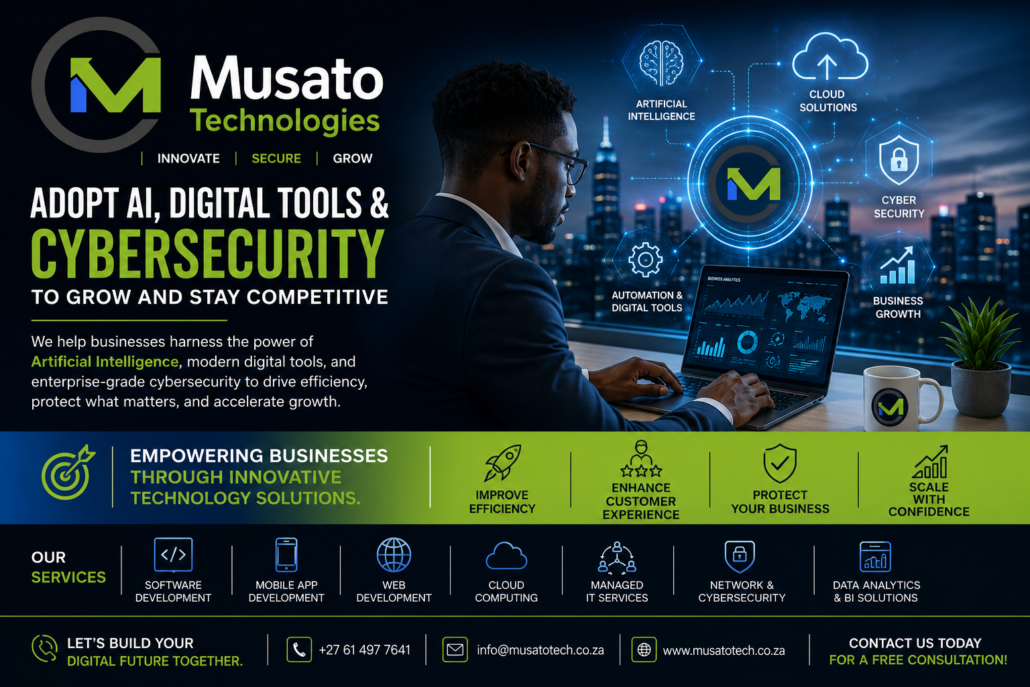
At Musato Technologies, we help businesses harness the power of Artificial Intelligence, Digital Transformation, Cloud Computing, Software Development, IT Infrastructure, Managed IT Services, Web Development, Mobile Applications, and Enterprise Cybersecurity Solutions. Whether you are modernizing existing systems or embarking on a complete digital transformation journey, our experienced team delivers innovative, secure, and scalable technology solutions tailored to your business objectives.
Contact Us Today
🌐 Website: https://musatotech.co.za
📧 Email: info@musatotech.co.za
📞 Phone: +27 61 497 7641
Future-proof your business today. Embrace AI, modern digital tools, and enterprise cybersecurity with Musato Technologies to accelerate growth, improve efficiency, and stay ahead of the competition. Contact us today for a tailored digital transformation strategy that delivers measurable results.
#ArtificialIntelligence #AI #DigitalTransformation #Cybersecurity #BusinessGrowth #Innovation #CloudComputing #DigitalTools #BusinessTechnology #ManagedITServices #SoftwareDevelopment #BusinessAutomation #DataSecurity #CloudSolutions #ITConsulting #EnterpriseSolutions #FutureOfWork #DigitalInnovation #MusatoTechnologies